SPF30+ vs SPF30 sunscreen showdown

SPF30+ vs SPF30 sunscreen showdown

If you saw a sunscreen that was marked ‘SPF30’ and one that was ‘SPF30+’, which do you think would be the better sunscreen? Asking yourself whether that’s a trick question, you’d be correct, strangely, it’s the SPF30.

spf30image

I don’t intend to cause a panic with this statement, they’re both providing 30x more protection than unprotected skin, but the devil is in the detail. Before I go any further and to avoid confusion, I want to be clear that the ‘+’ in SPF50+ sunscreen is unrelated to the faults i’ll be discussing here, SPF50+ are the ‘superior’ sunscreens, if you see SPF50 alongside SPF50+, the ‘+’ is the better option and I’ll explain that in more detail later.

The difference between the ‘+’ and the ‘plus-less’ for SPF30 sunscreens is not in whether one offers more SPF than the other. The difference is in which has more UVA protection and is impossible for the average consumer to know, in fact, it’s counter intuitive, consumers are being encouraged to buy the inferior sunscreen by association that ‘+’ is better than ‘plus-less’, which is a little disturbing.

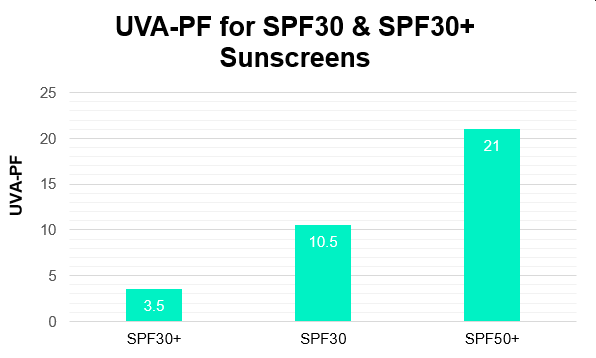
Realising we’re all time poor and save you some time, SPF30+ sunscreen has as low as 1/3 of the protection from UVA radiation (the radiation responsible for causing premature ageing and skin cancer) than an SPF30. Confused? Read on….

A radiation recap

To back track slightly, SPF is a measurement of protection against UVB radiation, those UV wavelengths that cause sunburn. UVA radiation are those wavelengths that cause skin pigmentation and are associated with skin cancers. The amount of sunburn protection is recognisable by the SPF value where SPF30 sunscreen will allow a person to spend 30x more time in the sun before they start to burn. The amount of UVA protection is far less obvious and is communicated by whether ‘broad-spectrum’ is claimed, generally SPF30/SPF30+ products both claim broad-spectrum.

Drawing 1

The Requirements

All sunscreen sold in Australia are required to comply with the Australian/New Zealand Standard (AS/NZS 2604) and have been for quite some time. In 2012 there was an update to the previous standard that had been in place since 1998 and this is where the confusion began. There is no question that the 2012 standard was a leap forward, it took the maximum claimable SPF from 30+ to 50+ (actually SPF60), so doubled the maximum protection, it also took a much better approach to how UVA protection was measured and what was required to claim ‘broad-spectrum’.

How is/was UVA protection determined?

In 1998, UVA performance was being tested using a number of different methods, one of which included dissolving sunscreen in a solvent and analysing it with a spectrophotometer, a tool typically reserved for the analysis of raw materials in industry. These methods bore no similarity to how we use sunscreen, it wasn’t applied to skin and wasn’t then exposed to the sun where bad sunscreens often start to fail. The test methods used prior to 2012 were inappropriate and ultimately inaccurate.

In 2012, the test became far more advanced, sunscreen was applied to a skin like substance and then placed in a solar simulator where the sunscreen is exposed to UV radiation, simulating actual sun which can cause degradation of the sunscreen. The sunscreen was then tested using a Labsphere sunscreen analyser, the results from the Labsphere are then processed and weighted against the SPF that was measured from human testing to calculate the UVA-PF. Whilst the new test is still technically ‘in-vitro’, it uses an in-vivo test as its basis, saving having to test on people more than necessary, risking the health of the test subjects.

To claim ‘broad-spectrum’ in 2012 and beyond, a sunscreen was required to have a UVA-PF of at least one third of the claimed SPF, for an SPF30 sunscreen, it needed a UVA-PF of at least 10. The 1998 requirement didn’t use UVA-PF as the basis of figuring out whether it was broad-spectrum, this combined with the different test methods means that 1998 sunscreens may not pass 2012 requirements.

To figure out how they compare, we need to test sunscreens that comply with the 1998 requirement using the 2012 methods. The below graph illustrates how these vary.  I have included SPF50+ to highlight the huge improvement in UVA-PF for SPF50+ sunscreens as compared to the old SPF30+ sunscreens.
Drawing 3

https://www.tga.gov.au/sunscreen-standard-2012-information-industry

How did this happen?

Unfortunately, some time around 2012, a decision was made that any sunscreen already in the market that complied to the 1998 requirements could continue to be sold indefinitely. This allowance applied only to existing sunscreens that were already listed with the TGA, any new sunscreens had to comply with the 2012 requirements.

I recall a justification for this around 2012 with an expectation that market forces would result in the 1998 compliant sunscreens drifting off shelves. Unfortunately, it’s been 5 years and the Australian public continues to have access to subpar sunscreens with no end in sight, we have all been let down somewhat by the government department that was supposed to be looking out for our health and wellbeing.

From a consumer perspective, I can understand the decision from a ‘cosmetic’ standpoint, where a consumer buys a foundation with SPF30+ for example, the primary purpose of the product is as to colour the skin and not to prevent sun-damage. I can appreciate that it would be difficult and also expensive for some brands to change their range of SPF15 lipsticks to comply with the new requirement.

On the flip-side, for a ‘therapeutic’ sunscreen, where the primary purpose is to prevent sun related damage, the consumer should be provided some assurances that the sunscreen they’re buying is of the highest standard.

Are SPF30+ sunscreens bad?

Not all sunscreens are created equally, there may well be some SPF30+ sunscreens that may comply with current requirements and just haven’t been tested to confirm. Mineral sunscreen particularly could be expected to comply as minerals including Zinc Oxide or Titanium Dioxide aren’t photo-unstable, others using more advanced sunscreen filters or effective combinations of filters are also likely to be OK. Photo-instability (i.e. a sunscreen that is photo-unstable) refers to the issue of a sunscreen degrading and a loss of performance during exposure to the sun.

Sunscreens that combine Butyl Methoxydibenzoylmethane and Octyl Methoxycinnamate are notoriously photo-unstable and since 2012, formulators have been forced to find alternate combinations, if you see these on your SPF30+ sunscreen, use with caution,

Making an informed decision

Some brands will identify whether they comply with the 1998 or the 2012 requirement on the back of the pack, it is not a legal requirement to declare which standard a sunscreen was tested to, so it’s not cut and dry, but can be an easy way to know whether you’re buying the best SPF30 sunscreen. Cancer Council is one example of a brand that will include a remark on which standard the product complies.

To be clear, if the sunscreen is an SPF50+ or if it’s claiming 30 (no ‘+’) it complies to the 2012 requirement and is a better sunscreen, if its SPF30+, it’s an inferior sunscreen, if its less than SPF30, it becomes difficult, if you’re planning on spending time in the sun, let’s be honest, you shouldn’t be picking up anything less than an SPF30.

With regard to SPF50 vs SPF50+, both comply to 2012 requirements, the difference is in the SPF, where SPF50+ indicates the tested SPF is between 50-60 and SPF50+ has an SPF of more than 60.

Brands to watch out for

A review of sunscreens in supermarkets and pharmacies was undertaken to identify which brands continue to include SPF30+. Some brands may have already discontinued their SPF30+ products, however are still available via retail channels, this list is in no way exhaustive:

SPF30Image2

*Mineral based, may be OK

**Aerosol based, steer very clear

A side note, be wary when buying online, descriptions on retailer websites may refer to SPF30 when its SPF30+ and vice versa. Products are best bought when you can read the label and check the standard the sunscreen was tested and cite the physical label.

What can we do?

All we can do to protect ourselves is to be aware and make a more conscious effort when sunscreen shopping. Avoid SPF30+ sunscreen and any temptation that may go with a potentially cheaper option and tell your friends and family too, knowledge shared is knowledge gained!

Boycotting SPF30+ will help to stop brands manufacturing old and outdated sunscreens or at least go some way to force their hand to have them perform the necessary testing to comply with the 2012 standard. Continuing to buy SPF30+ only encourages the brand to keep making them.

In the SPF30+ vs SPF30 sunscreen showdown, SPF30 wins!

Edit (17/4/2018)

Following original publication, I was contacted by Skin Health, the brand managing organisation behind Cancer Council sunscreen. It was highlighted that the SPF30+ Everyday Sunscreen range had been discontinued in 2012 . Although I wasn’t able to find  Cancer Council SPF30+ Everyday Sunscreen in store and had observed the newer ‘SPF30’ variants being sold, I had found that there had been many online retailers/pharmacies that gave the impression SPF30+ were still in the market as they hadn’t updated their product pages along with a Cancer Council promotion that had SPF30+ imagery being used. Skin Health are now working with retailers and pharmacies to correct this so all Everday variants are good Everyday variants.

Cancer Council continue to have one SPF30+ variant in the Repel range, but have indicated that this is earmarked to be replaced by SPF50+ soon.

SolarD, Vitamin D and Sun Protection

SolarD, Vitamin D and Sun Protection

SolarD sunscreen was introduced into the Australian market in late 2014, advertised as being a technologically advanced formula that permits the particular wavelengths of ultra-violet light that your body uses to naturally produce vitamin D. The concept for this product is new and no doubt of interest to consumers with the increasing concerns over their vitamin D levels and reports that regular sunscreens prevent vitamin D production. Without suggesting that people should avoid using SolarD, I do feel that it should be used with caution and appropriate consideration for their sunscreen needs, lifestyle and the recommendation of their doctor.

SolarDSPF50DailyUse

Importance of vitamin D

Vitamin D, as with all vitamins are essential to our health, vitamin D helps the absorbtion of minerals including; calcium, iron, magnesium, phosphate and zinc, all of which are critical to bone health. Being deficient in vitamin D can cause rickets, osteomalacia and osteoporosis and has been linked to cancer, various auto-immune, cardiovascular disease and mental health.

The recommended daily amount (RDA) of vitamin D for adults who do not have a vitamin D deficiency is 600IU, this is equivalent to 0.0000015g (15µg).

Sources of vitamin D

There are two types of vitamin D, D2 and D3; vitamin D2 is found in mushrooms and ‘fortified foods’ such as milk, margarine and breakfast cereals where the vitamins have been artificially added. Sources of vitamin D3 include foods such as salmon and other oily fish, eggs and milk in addition to fortified foods and vitamin D supplements, vitamin D is also produced through sun exposure.

Vitamin D3 is the most potent and effective type of vitamin D with sun exposure being the most efficient means of attaining our vitamin D3.

The most concentrated dietary source of vitamin D is found in wild salmon which has up to 1000IU of vitamin D3 in every 100g. Turns out that a salmon a day could keep the vitamin D deficiency away, unfortunately, eating salmon everyday is not great for a balanced diet, which is why sun exposure is important.

Vitamin D3 and sun exposure

Producing vitamin D3 through sun exposure is a complex reaction that occurs within our skin, requiring sun light to drive the reaction, specifically the wavelengths of light between 270 and 320nm. Visible light are those wavelengths between 390-700nm, as the wavelengths of light required to produce vitamin D3 are below those of the visible, they are ‘ultra-violet’ (UV) wavelengths which we can call UV light.

The amount of vitamin D3 produced when exposing ourselves to sun light will vary considerably with the amount of exposed skin, age, height, skin color, time of day, season, longitude and altitude, from as little as a few minutes in summer, to a few hours in winter. Interestingly, the amount of vitamin D generated in the skin is limited, to the point where longer exposure to sun light will not necessarily increase our vitamin D levels, unlike the risk of skin damage and skin cancer which will increase the longer we spend in the sun.

Causes of sunburn and the vitamin D paradox

Ultra-violet B (UVB) light refers to those wavelengths of light between 280 and 315nm, Ultra-violet A (UVA) are those wavelengths between 315 and 390nm. The UVB wavelengths are most responsible for causing sunburn, but are also responsible for causing skin cancer and other sun damage, particularly premature ageing such as wrinkles and sun spots. The method used to test the sun protection factor (SPF) of a product uses sunburn as the endpoint to determine whether the product is providing protection simply because the sunburn is an indicator of sun damage that is (close to) immediately visible and easily measured.

You may now note that the wavelengths of light that are required to produce of vitamin D3 detailed above are the same as those that cause sunburn. A sunscreen that is aimed to prevent sunburn and that is promoted to permit the particular UVB light that your body uses to naturally produce vitamin D3 should be physically impossible.

A look at how Solar D works

The UV absorbtion spectrum of SolarD SPF50 sunscreen in comparison to a regular SPF50+ Sunscreen (below) shows SolarD absorbs less light in the UVB (280 – 315nm) region than a standard sunscreen, which goes to justify the claim that SolarD permits the particular UVB light that produce vitamin D3, but doesn’t necessarily support the SPF50 claim.

SolarDvsRegularSunscreenAbsorbtion

How does SolarD make sun protection claims if there isn’t enough UVB absorbtion to prevent sunburn?

Before I go into any further detail and to place the remainder of this article in context, I must highlight that I am not aware of SolarD’s technology or formulation so I do not know with any certainty how SolarD achieves their claims. Being involved in the development of sunscreens (as I am) and having been aware of the health issues surrounding vitamin D, I had already considered ways that a sunscreen can promote vitamin D production and protect against sunburn, they are unusual and in my mind, not necessarily in the consumers best interest.

Sunburn is only one symptom of sun exposure, it is the one we readily relate to as we see and feel it so soon after we have been in the sun, other symptoms include skin cancer and premature ageing such as wrinkles and sun spots. We often treat sunburn using after sun products containing anti-inflammatory ingredients such as aloe vera and green tea and also anaesthetics like lidocaine, but these products won’t undo the damage that has already been caused, only reduce the redness/pain we can see and feel.

A sunscreen could, in theory, have a high sun protection factor (SPF) without the need for the product to absorb a lot of UV light by treating the visible symptoms of sun exposure we know as sunburn. A product such as this would be reliant on those same anti-inflammatory ingredients used in after sun products to compensate for a reduction in UV absorbance relative to that of a normal sunscreen. The issue here is that by failing to absorb as much UV light, more damaging UV light will be allowed to pass through to the skin where damage will occur despite the sunburn having been masked by the ant-inflammatory action. We could liken this to spraining your ankle whilst on pain and anti-inflammatory medication, the damage was done, the ankle is now weak and unstable, we just can’t feel it and in no way was the damage prevented.

I am not suggesting that this is how SolarD functions, without seeing the product technology in its entirety; this is only my theory on how the product may perform and something worth being mindful of.

Vitamin D production vs sun protection

The primary purpose for any sunscreen is to minimize sun damage by absorbing the UV light and reducing the risks of sunburn, skin cancer and premature ageing when we’re out in the sun. Realizing that sunscreens have an obvious potential to alter the way vitamin D3 is formed and influence vitamin D deficiency and related diseases, we need to instill a balanced approach so that we get enough sun exposure to allow vitamin D production, but not so much as to cause sun damage.

While wearing a regular SPF50+ sunscreen in summer will slow the formation of vitamin D3, the small amount of UV light which does pass through over the period of a few hours will generate the same amount of vitamin D3 as spending a few minutes without sunscreen with the added benefit of their being less risk of damaging the skin and there have been studies that show this to be the case.

We should all use sunscreen whenever there is a risk of sunburn, if there is no risk of sunburn, there is no need to wear sunscreen, if in doubt though, your best to have sunscreen on. If you’re going to be outdoors outside peak sunburn times (early morning or late afternoon) or only for very short periods during the day, there is no need to apply sunscreen, by doing so, our bodies will be produce vitamin D3. For those who have concerns relating to premature ageing such as wrinkles and sun spints and prefer to wear sunscreen at all times, then SolarD may be a good option to minimize damage without inhibiting vitamin D too much, a lower SPF sunscreen would however have a similar effect.

For those who are planning on spending a lot of time in the sun, especially at the beach, pool or playing sport, your best to wear a 4 hour water resistant SPF50+ sunscreen for maximum protection, remembering the sunscreen will allow vitamin D3 to be formed. I stress this point because SolarD, being a 2 hour water resistant SPF50 sunscreen has 15-20% less SPF and half the water resistance of a 4 hour water resistant SPF50+ which is not going to provide the best protection.


To buy SolarD or not to buy SolarD

I don’t want to discourage people from using SolarD, it’s an interesting concept that will have a place on the market, however it does complicate the decision making process, particularly for those who believe their existing sunscreen is somehow less effective in terms of allowing vitamin D production to occur.

If you haven’t been diagnosed with a vitamin D deficiency, then your current lifestyle and existing sunscreen habits are working for you, there is no need for a product like SolarD. For those who have been diagnosed with a vitamin D deficiency, your doctor would offer the best solution with consideration for minor lifestyle changes to get more sun, using vitamin D supplements and perhaps recommend SolarD.

References

  1. Olds, 2010; Elucidating the Links Between UV Radiation and Vitamin D Synthesis; Using an In Vitro Model, Queensland University of Technology.