Ocean safety and sunscreen ingredients

Ocean safety and sunscreen ingredients

Think you know all about reef safety, coral bleaching and reef safe products? You might be surprised. Click here to read our overview blog – Reef safe products – crisis or con?

What’s it all about?

  • Where contamination is unavoidable, use chemicals that are ecologically safe to minimise harm
  • Non ecologically safe sunscreen actives include all forms of Zinc Oxide (which are incorrectly believed to be reef safe), along with Octocrylene, Octyl Salicylate and Benzophenone-3 (Oxybenzone)
  • Protective clothing and minimising sunscreen use can help minimise the impact on oceans
  • Highly water resistant sunscreens help minimise unwanted contamination of the ocean environment

Zinc Oxide – not all it’s cracked up to be?

In this blog it’s discussed where the claims of ‘reef safe’ products and chemicals originated; a US-based environmental laboratory undertaking experimental research that aimed to directly link a sunscreen active to coral bleaching.

Contrary to the laboratories suggestion that ‘non nano’ Zinc Oxide is a non marine pollutant, and by association, non coral bleaching (somehow excluding nanoparticles), there is research that suggests uncoated Zinc Oxide can contribute to coral bleaching and the European Chemicals Agency (ECHA) aquatic hazard classification categorised Zinc Oxide as being very toxic to marine life with long lasting effects.

Primary vs secondary particles sizing 

The laboratory implies that ‘non nano’ Zinc Oxide(i.e. larger than 100 nm in size) is miraculously safe as compared to ‘nano’ Zinc Oxide (i.e. less than 100 nm in size), as one may expect, safety and toxicity associated with ‘small’ and ‘smaller’ is unlikely to be that black and white (101nm is ok?). 

The vast majority of sunscreen grade Zinc Oxide have what we refer to as ‘primary particles’ that are nano in size, which is what makes them highly effective sunscreens. It is these primary particles that then form tightly held, larger aggregates which are referred to as the ‘secondary particle’ that by definition makes them non nano (despite being nano).

Beyond ‘reef safe’ to ‘ocean safe’

Over the past decade, consumers have increased their focus on carbon footprints, global warming and harm minimisation for future generations. 

Whilst the concern that sunscreens are impacting reefs is likely to be largely unwarranted, in the context of global warming and increasing ocean temperatures, we should continue to minimise our impact on oceans which of course affects  other marine life including fish, crustaceans, molluscs etc, particularly in areas that have a rich ecosystem, which is often around reefs.


How do we protect ourselves and the oceans?

Whilst we must care for the environment and do everything we can to minimise unnecessary damage, we need to also protect ourselves.  The harm sunscreens may cause to coral reefs is not well defined, in contrast, the harm not wearing sunscreen causes to humans is undeniable and we must find a balance. 

Some suggestions include:

  • Swim in a pool and not in the ocean if possible. Whilst pool water will be contaminated and eventually end up in the sewer system, the treatment process can be expected to remove contaminants with effluent kept away from beaches and reefs
  • If swimming in beaches, pick ones away from reefs and other rich ecosystems
  • Wear protective clothing (high UPF long sleeve rash vests, hats etc) to minimise the amount of skin requiring sunscreen
  • Do not automatically go for ‘mineral’, ‘natural’ and ‘non-nano’ sunscreens which are often perceived as safest
  • Use an eco-friendly sunscreen, avoid anything with Zinc Oxide, Octocrylene, Benzophenone-3 and Octyl Salicylate
  • Ensure the sunscreen has the maximum water resistance possible, an Australian-made 4hr water resistant sunscreen is always preferable over an 80 minute resistance


What is an eco-friendly sunscreen?

Although the majority of sunscreens are perfectly fine for everyday use in and around a pool, when selecting sunscreens to use in lakes, rivers and beaches, we should avoid sunscreens that use active ingredients associated with eco toxicity where possible, using the ECHA classifications as a guide. 

ECHA eco toxicity classifications of sunscreen active ingredients

HIGH RISK

  • Zinc Oxide
  • Octocrylene
  • Octyl Salicylate
  • Benzophenone-3 (Oxybenzone)

LOW RISK

  • Octyl Triazone
  • Octyl Methoxycinnamate (Octinoxate)
  • 4-Methylbenzylidene Camphor

Instead, focus on ingredients that haven’t been associated with causing toxicity or have otherwise negligible levels of risk.

POSSIBLE RISK

  • Methylene Bis-Benzotriazolyl Tetramethylbutylphenol
  • Diethylamino Hydroxybenzoyl Hexyl Benzoate

NEGLIGIBLE RISK

  • Titanium dioxide
  • Phenylbenzimidazole Sulfonic Acid
  • Homosalate
  • Avobenzone
  • Bis-Ethylhexyloxyphenol Methoxyphenyl Triazine 
  • Tris Biphenyl Triazine 

The EcoSun Pass

EcoSun is a proprietary system developed by global leader in sunscreen chemical development and the world’s largest chemical producer, BASF. The EcoSun system quantifies the environmental safety of sunscreen actives and their usage concentrations based on a variety of factors including:

  • Acute aquatic toxicity
  • Chronic aquatic toxicity
  • Biodegradability
  • Bioaccumulation
  • Endocrine suspicion
  • Terrestrial toxicity
  • Sediment toxicity

To achieve EcoSun Pass certification, BASF set a target score of >200 however, the algorithm and combination of the above factors is proprietary and therefore unknown. 

An example of how the EcoSun system works; at a 10% dosage of a single sunscreen chemical, the ‘high risk’ ingredients score poorly; Zinc Oxide a paltry ‘37’, Octocrylene, Octyl Salicylate ‘0’ and Benzophenone ‘77’. In contrast, the negligible risk ingredients score far better; Bemotrizinol ‘302’, Titanium Dioxide ‘148’ (still not as good as some modern synthetic chemicals) and Tris-Biphenyl Triazine ‘189’.

We did find a minor flaw in the algorithm logic, where we would assume using less of any chemical ingredient would be better for the environment and result in a higher score, or at a minimum, have the same score regardless of dose which enables a EcoSun rating against active concentration. Unfortunately, in some cases the system appears to encourage higher usage levels to achieve higher ratings, which is counterintuitive, as the best scores should be as the dosage approaches zero and less actives enter the environment. 

As an example a 50/50 blend of Bemotrizinol and Tris-Biphenyl Triazine:

5% – 268

10% – 285

15% – 300

20% – 312

Admittedly the scores are quite good and all exceed the 200 required for certification however this is not factoring in the resulting SPF. In combination with other sunscreen chemicals, it is perhaps pushing BASF proprietary chemicals and less economical active ingredients.

Oddly, this flaw was corrected when using another active (Avobenzone) and less erratic when looking at others individually, all that aside, this is a great tool.

Avobenzone:

2.5% – 149

5.0% – 98

7.5% – 69

10% – 53

Interestingly, it seems individual ingredients that scored zero, including Octocrylene and Octyl Salicylate, would cause an otherwise favourable combination of ingredients to immediately be scored zero at any combination.

Combining EcoSun value with the BASF sunscreen simulator (which enables in silico estimates of sunscreen performance), a high-performing sunscreen capable of an EcoSun Pass of 238 is feasible using the following sunscreen chemicals:

Titanium Dioxide, Tris Biphenyl Triazine, Phenylbenzimidazole Sulfonic Acid, Butyl Methoxydibenzoylmethane & Bis-Ethylhexyloxyphenol Methoxyphenyl Triazine

The above combination was estimated to achieve an SPF of 62.5 and a UVA-PF of 21.4

An all-mineral formulation based on either Zinc Oxide, Titanium Dioxide or a combination of both are not capable of achieving broad spectrum SPF50+ and an EcoSun value of >200. 


Maximise the water resistance and minimise the contamination

Having an entirely waterproof sunscreen would be a solution to the concern of sunscreen chemicals entering waterways. However whilst an entirely waterproof sunscreen may not be practical, some sunscreens are far more resistant to wash off than others, and the ‘water resistance’ claims on packaging only go so far as to communicating how resistant they are.

Australian water resistant sunscreens are on balance more water resistant than their overseas counterparts, as a consequence of how the test results are interpreted to make the claim, but also as a result of higher time periods (80 minutes vs 4 hours). 

Sunscreens that make water resistance claims in Australia are required to maintain the claimed amount of SPF after immersion in water. So if claiming SPF50 and 4hr water resistance, the sunscreen must still be SPF50 after 4 hrs. In contrast, a US or EU SPF50 sunscreen, which can only claim 80 minutes water resistance (1/3rd of what an Australian product can), is permitted to be SPF 25 after 80 minutes. 

What this means in simplistic terms is that half of the sunscreen is allowed to wash off after 80 minutes, potentially it has all washed off after 4 hours, whereas the Australian sunscreen has not washed off at all after that same time period.

Worst-case allowable SPF claims and water resistance

This is a fairly extreme example and there are likely to be European sunscreens that are extraordinarily water resistant by chance rather than design.

Unfortunately, there is currently no measure of water resistance indicating ‘how much will end up in the ocean’, something that could become a feature of future sunscreens or a proven claim relating to ocean safety.

How do I formulate a product?

How do I formulate a product?

So, you have a great idea for a new product, but you aren’t sure what’s next? There are a few steps between a wonderful idea and uploading products to your website or being stocked at your favourite retailer
Reef safe products – crisis or con?

Reef safe products – crisis or con?

What’s it all about?

  • The term ‘reef safe’ positions itself alongside coral bleaching, which incorrectly implies that chemicals are the cause of the bleaching
  • Coral bleaching can be caused by a number of factors, however rising ocean temperature is the most likely
  • Whilst some sunscreen chemicals have been associated with coral bleaching, the link is tenuous, regardless of this it clearly it’s preferable to minimise the contamination of beaches and waterways

What is reef safety?

Reef safety is a term used to broadly suggest a product, particularly a sunscreen, is safe for use at beaches and other areas surrounding coral reefs. These claims are based on the questionable belief that some sunscreen active ingredients cause coral bleaching. We say it is questionable as it is associated with observations of coral bleaching in reef areas and the perceived correlation between human activity, sunscreen chemicals in the waterways and the bleaching of coral.

The term “reef safe” has no firm definition and is not regulated by any independent, impartial authority, instead, it is a concept that many brands use at an increasing frequency to differentiate their product in a competitive market.


Coral bleaching

Coral bleaching occurs when the coral expels the symbiotic algae that lives within the coral tissue, this algae is responsible for the colouration (zooxanthellae) that’s associated with healthy coral. The algae is expelled as a result of an external stressor in the form of changes in the surrounding environment, including nutrients in the water, light and temperature (but also reportedly associated with sunscreen chemicals).

Coral that has become “bleached” is at risk of dying, yet when the external stressor is not severe or prolonged in nature, the symbiotic algae can return and the coral recovers. In contrast, when the stress is severe and prolonged, the coral which has now become exposed to the stress that the algae had protected it from can then die.

There is evidence of coral bleaching globally, which is a major environmental concern. However, it must be noted that the actual cause is not well understood and is an area of active research.

The term ‘coral bleaching’ can be harshly interpreted. We immediately associate ‘bleaching’ with chemicals used around the home and ‘bleach’ as the adopted term for any chemical that causes whitening. It is for this reason that coral bleach is better referred to as ‘coral decolorisation’ to remove the stigma that inevitably accompanies the word ‘bleach’ because of the understanding that chemicals are not the most likely cause of damage.

Sunscreens have been associated with contributing to coral bleaching, however it is important to understand that coral reefs are threatened by an ever-increasing number of sources. These include climate change and increased ocean temperatures, along with marine-based diseases, coastal development and an array of chemical contaminants from agriculture and other sources.


Why increasing ocean temperatures are the most likely cause

During the 20th century water temperatures increased at a rate of 0.08degC every 10 years on average, however average temperatures in shallow coastal regions (where reefs are typical) are likely higher due the effects of sun exposure on the water, changing tides and the associated water depths.

The Great Barrier Reef has been impacted by several bleaching events, most recently in the years 2016, 2017 and 2020. Unlike the beaches of Hawaii, parts of the Great Barrier Reef aren’t exposed to considerable amounts of human activity and are incredibly remote, so to draw a correlation between sunscreen and coral bleaching of this reef is quite the reach.

A report by the Intergovernmental Panel on Climate Change advised that coral reefs worldwide are projected to decline by a further 70-90% at a 1.5°C increase in temperature, with greater losses at a 2.0°C increase. Based on the above 0.08degC increases, this means that the 70-90% decline will occur in ~190 years from now and the greater (and presumably final) losses in ~250 years.


Why sunscreen is in the firing line

Sunscreens have been linked to coral bleaching, in part, by the unsurprising detection of sunscreen ingredients around swimming beaches and the observation of coral bleaching events in the surrounding reef areas.

The highest rates of detection are in densely populated regions, particularly areas with high levels of tourism in tropical locations where coral reefs are common (Hawaii, Fiji, Australia, Indonesia, the Caribbean etc). Despite measurable amounts of sunscreen chemicals detected in the water surrounding beaches, this does not mean that sunscreens are the cause, this is an example of a spurious correlation – where variables appear to be causal but are not.

The concentrations of sunscreen chemicals detected in sea water vary significantly, however overall, the dosages are incredibly low and in the order of parts per trillion (ng L-1).

The detection of sunscreen chemicals in beaches triggered an entrepreneurial US-based environmental laboratory to undertake experimental research that aimed to directly link a sunscreen active to coral bleaching.

This environmental laboratory then published a questionable research paper indicating that Oxybenzone (Benzophenone-3), contributed to coral bleaching. This finding doesn’t appear to have been replicated by other research laboratories and has been contradicted entirely by others including a study in Bermuda by the Bermuda Institute of Ocean Sciences in partnership with Scripps Institution of Oceanography – University of California.

The environmental laboratories research does not appear to have been repeated for other purportedly “non reef safe” sunscreen ingredients like Octinoxate (Octyl Methoxycinnamate) or Octocrylene for example, yet the laboratory suggests on their website a wide array of sunscreen actives are harmful, despite not having been tested in the same manner as Oxybenzone, and that other untested actives are miraculously safe.

This environmental laboratory now acts as an authority and certifier for brands to include an “environmental and reef safety certification”. This is granted on the basis of a sunscreen being absent of sunscreen chemicals that have not been tested and is simply a half-baked paper-based safety assessment. Had the individual sunscreens been tested for their impact on reefs (or associated algae) in-vivo, incorporating other formulations ingredients that may promote penetration of potentially toxic compounds that increases risk, then and only then, would such a certification truly have merit.

It must be noted (Oxybenzone) Benzophenone-3 is very uncommon in Australia and Europe due to being a photo allergen that can cause sensitisation when exposed to sunlight and a potentially endocrine disrupting chemical.

However, it is extremely common in the US who have far less approved options for sunscreen ingredients at their disposal.

The questionable ‘not reef safe’ list

The same American environmental testing laboratory has published a list of all supposedly ‘unsafe ingredients. 

Below is a consolidated list of all sunscreen actives available globally, some of which are apparently ‘unsafe’ according to the testing laboratory and compares this finding with the European Chemicals Agency (ECHA) aquatic hazard classification. The ECHA manages the technical and administrative aspects of the implementation of the European Union regulations.

Sunscreen active ingredients testing laboratory stance vs ECHA classification

Active Ingredient
Listed “unsafe” by US laboratory
Tested for coral bleaching potential
ECHA aquatic hazard toxicity classification
Benzophenone-3 (Oxybenzone)
Yes
Yes
Very toxic to aquatic life with long lasting effects
Zinc Oxide
Yes
No
Very toxic to aquatic life with long lasting effects
Zinc Oxide (nano)
Yes
No
Very toxic to aquatic life with long lasting effects
4-Methylbenzylidene Camphor
No
No
Very toxic to aquatic life with long lasting effects
Ethylhexyl Salicylate
No
No
Very toxic to aquatic life with long lasting effects
Isoamyl p-Methoxycinnamate
Yes
No
Very toxic to aquatic life with long lasting effects
Octocrylene
Yes
No
Very toxic to aquatic life with long lasting effects
Ethylhexyl Methoxycinnamate (Octinoxate)
No
No
Toxic to aquatic life with long lasting effects
Polysilicone-15
No
No
Harmful to aquatic life with long lasting effects
Methylene Bis-Benzotriazolyl Tetramethylbutylphenol
No
No
May cause long lasting harmful effects to aquatic life
Diethylamino Hydroxybenzoyl Hexyl Benzoate
No
No
May cause long lasting harmful effects to aquatic life
Ethylhexyl Triazone
No
No
May cause long lasting harmful effects to aquatic life
Butyloctyl Salicylate
No
No
May cause long lasting harmful effects to aquatic life
Bis-Ethylhexyloxyphenol Methoxyphenyl Triazine
Yes
No
Non hazardous
Avobenzone
No
No
Non hazardous
Disodium Phenyl Dibenzimidazole Tetrasulfonate (Neo Heliopan® AP)
No
No
Non hazardous
Drometrizole Trisiloxane
No
No
Non hazardous
Menthyl Anthranilate
No
No
Non hazardous
Terephthalylidene Dicamphor Sulfonic Acid (Mexoryl® SX)
Yes
No
Non hazardous
Ethylhexyl dimethyl PABA
No
No
Non hazardous
Homomenthyl Salicylate (Homosalate)
No
No
Non hazardous
Phenylbenzimidazole Sulfonic Acid
No
No
Non hazardous
Titanium Dioxide
No
No
Non hazardous
Titanium Dioxide (nano)
No
No
Non hazardous
Tris-Biphenyl Triazine
No
No
Non hazardous
Ethylhexyl Methoxycrylene (SolaStay® S1)
No
No
Non hazardous
PEG-25 PABA
No
No
Not determined
Polyester-8 (Polycrylene)
No
No
Not determined

Learn more about the environment and water safety via the blog ocean safety and sunscreen ingredients.

How do I formulate a product?

How do I formulate a product?

So, you have a great idea for a new product, but you aren’t sure what’s next? There are a few steps between a wonderful idea and uploading products to your website or being stocked at your favourite retailer

SPF30+ vs SPF30 sunscreen showdown

SPF30+ vs SPF30 sunscreen showdown

If you saw a sunscreen that was marked ‘SPF30’ and one that was ‘SPF30+’, which do you think would be the better sunscreen? Asking yourself whether that’s a trick question, you’d be correct, strangely, it’s the SPF30.

spf30image

I don’t intend to cause a panic with this statement, they’re both providing 30x more protection than unprotected skin, but the devil is in the detail. Before I go any further and to avoid confusion, I want to be clear that the ‘+’ in SPF50+ sunscreen is unrelated to the faults i’ll be discussing here, SPF50+ are the ‘superior’ sunscreens, if you see SPF50 alongside SPF50+, the ‘+’ is the better option and I’ll explain that in more detail later.

The difference between the ‘+’ and the ‘plus-less’ for SPF30 sunscreens is not in whether one offers more SPF than the other. The difference is in which has more UVA protection and is impossible for the average consumer to know, in fact, it’s counter intuitive, consumers are being encouraged to buy the inferior sunscreen by association that ‘+’ is better than ‘plus-less’, which is a little disturbing.

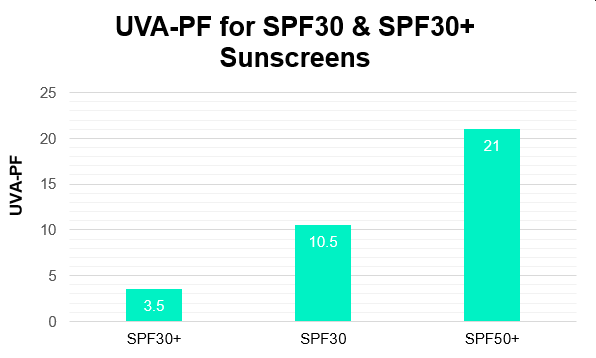
Realising we’re all time poor and save you some time, SPF30+ sunscreen has as low as 1/3 of the protection from UVA radiation (the radiation responsible for causing premature ageing and skin cancer) than an SPF30. Confused? Read on….

A radiation recap

To back track slightly, SPF is a measurement of protection against UVB radiation, those UV wavelengths that cause sunburn. UVA radiation are those wavelengths that cause skin pigmentation and are associated with skin cancers. The amount of sunburn protection is recognisable by the SPF value where SPF30 sunscreen will allow a person to spend 30x more time in the sun before they start to burn. The amount of UVA protection is far less obvious and is communicated by whether ‘broad-spectrum’ is claimed, generally SPF30/SPF30+ products both claim broad-spectrum.

Drawing 1

The Requirements

All sunscreen sold in Australia are required to comply with the Australian/New Zealand Standard (AS/NZS 2604) and have been for quite some time. In 2012 there was an update to the previous standard that had been in place since 1998 and this is where the confusion began. There is no question that the 2012 standard was a leap forward, it took the maximum claimable SPF from 30+ to 50+ (actually SPF60), so doubled the maximum protection, it also took a much better approach to how UVA protection was measured and what was required to claim ‘broad-spectrum’.

How is/was UVA protection determined?

In 1998, UVA performance was being tested using a number of different methods, one of which included dissolving sunscreen in a solvent and analysing it with a spectrophotometer, a tool typically reserved for the analysis of raw materials in industry. These methods bore no similarity to how we use sunscreen, it wasn’t applied to skin and wasn’t then exposed to the sun where bad sunscreens often start to fail. The test methods used prior to 2012 were inappropriate and ultimately inaccurate.

In 2012, the test became far more advanced, sunscreen was applied to a skin like substance and then placed in a solar simulator where the sunscreen is exposed to UV radiation, simulating actual sun which can cause degradation of the sunscreen. The sunscreen was then tested using a Labsphere sunscreen analyser, the results from the Labsphere are then processed and weighted against the SPF that was measured from human testing to calculate the UVA-PF. Whilst the new test is still technically ‘in-vitro’, it uses an in-vivo test as its basis, saving having to test on people more than necessary, risking the health of the test subjects.

To claim ‘broad-spectrum’ in 2012 and beyond, a sunscreen was required to have a UVA-PF of at least one third of the claimed SPF, for an SPF30 sunscreen, it needed a UVA-PF of at least 10. The 1998 requirement didn’t use UVA-PF as the basis of figuring out whether it was broad-spectrum, this combined with the different test methods means that 1998 sunscreens may not pass 2012 requirements.

To figure out how they compare, we need to test sunscreens that comply with the 1998 requirement using the 2012 methods. The below graph illustrates how these vary.  I have included SPF50+ to highlight the huge improvement in UVA-PF for SPF50+ sunscreens as compared to the old SPF30+ sunscreens.

Drawing 3

https://www.tga.gov.au/sunscreen-standard-2012-information-industry

How did this happen?

Unfortunately, some time around 2012, a decision was made that any sunscreen already in the market that complied to the 1998 requirements could continue to be sold indefinitely. This allowance applied only to existing sunscreens that were already listed with the TGA, any new sunscreens had to comply with the 2012 requirements.

I recall a justification for this around 2012 with an expectation that market forces would result in the 1998 compliant sunscreens drifting off shelves. Unfortunately, it’s been 5 years and the Australian public continues to have access to subpar sunscreens with no end in sight, we have all been let down somewhat by the government department that was supposed to be looking out for our health and wellbeing.

From a consumer perspective, I can understand the decision from a ‘cosmetic’ standpoint, where a consumer buys a foundation with SPF30+ for example, the primary purpose of the product is as to colour the skin and not to prevent sun-damage. I can appreciate that it would be difficult and also expensive for some brands to change their range of SPF15 lipsticks to comply with the new requirement.

On the flip-side, for a ‘therapeutic’ sunscreen, where the primary purpose is to prevent sun related damage, the consumer should be provided some assurances that the sunscreen they’re buying is of the highest standard.

Are SPF30+ sunscreens bad?

Not all sunscreens are created equally, there may well be some SPF30+ sunscreens that may comply with current requirements and just haven’t been tested to confirm. Mineral sunscreen particularly could be expected to comply as minerals including Zinc Oxide or Titanium Dioxide aren’t photo-unstable, others using more advanced sunscreen filters or effective combinations of filters are also likely to be OK. Photo-instability (i.e. a sunscreen that is photo-unstable) refers to the issue of a sunscreen degrading and a loss of performance during exposure to the sun.

Sunscreens that combine Butyl Methoxydibenzoylmethane and Octyl Methoxycinnamate are notoriously photo-unstable and since 2012, formulators have been forced to find alternate combinations, if you see these on your SPF30+ sunscreen, use with caution,

Making an informed decision

Some brands will identify whether they comply with the 1998 or the 2012 requirement on the back of the pack, it is not a legal requirement to declare which standard a sunscreen was tested to, so it’s not cut and dry, but can be an easy way to know whether you’re buying the best SPF30 sunscreen. Cancer Council is one example of a brand that will include a remark on which standard the product complies.

To be clear, if the sunscreen is an SPF50+ or if it’s claiming 30 (no ‘+’) it complies to the 2012 requirement and is a better sunscreen, if its SPF30+, it’s an inferior sunscreen, if its less than SPF30, it becomes difficult, if you’re planning on spending time in the sun, let’s be honest, you shouldn’t be picking up anything less than an SPF30.

With regard to SPF50 vs SPF50+, both comply to 2012 requirements, the difference is in the SPF, where SPF50+ indicates the tested SPF is between 50-60 and SPF50+ has an SPF of more than 60.

Brands to watch out for

A review of sunscreens in supermarkets and pharmacies was undertaken to identify which brands continue to include SPF30+. Some brands may have already discontinued their SPF30+ products, however are still available via retail channels, this list is in no way exhaustive:

SPF30Image2

*Mineral based, may be OK

**Aerosol based, steer very clear

A side note, be wary when buying online, descriptions on retailer websites may refer to SPF30 when its SPF30+ and vice versa. Products are best bought when you can read the label and check the standard the sunscreen was tested and cite the physical label.

What can we do?

All we can do to protect ourselves is to be aware and make a more conscious effort when sunscreen shopping. Avoid SPF30+ sunscreen and any temptation that may go with a potentially cheaper option and tell your friends and family too, knowledge shared is knowledge gained!

Boycotting SPF30+ will help to stop brands manufacturing old and outdated sunscreens or at least go some way to force their hand to have them perform the necessary testing to comply with the 2012 standard. Continuing to buy SPF30+ only encourages the brand to keep making them.

In the SPF30+ vs SPF30 sunscreen showdown, SPF30 wins!

Edit (17/4/2018)

Following original publication, I was contacted by Skin Health, the brand managing organisation behind Cancer Council sunscreen. It was highlighted that the SPF30+ Everyday Sunscreen range had been discontinued in 2012 . Although I wasn’t able to find  Cancer Council SPF30+ Everyday Sunscreen in store and had observed the newer ‘SPF30’ variants being sold, I had found that there had been many online retailers/pharmacies that gave the impression SPF30+ were still in the market as they hadn’t updated their product pages along with a Cancer Council promotion that had SPF30+ imagery being used. Skin Health are now working with retailers and pharmacies to correct this so all Everday variants are good Everyday variants.

Cancer Council continue to have one SPF30+ variant in the Repel range, but have indicated that this is earmarked to be replaced by SPF50+ soon.

More is more, how much sunscreen to apply?

More is more, how much sunscreen to apply?

Despite high SPF50+ sunscreens on the market that are capable of providing hours of protection from sun damage, it’s an unfortunate reality that people continue to become sun burnt while wearing sunscreen. The reasons why we’re still getting sun burnt are simple – we aren’t applying enough sunscreen to properly protect ourselves. Having done some investigation, I was incredibly surprised exactly how important applying the recommended amount of sunscreen is and that applying anything less gives an almost catastrophic reduction in protection.

Sunscreen testing and certification

Before going into detail, it’s worth noting that the sun protection factor (SPF) claimed on packaging have been certified in a laboratory under very detailed conditions relating to the amount of product applied to a surface area (for the technical people, its 2mg/cm-2). For your sunscreen to achieve the claimed SPF, it must be applied in the same manner and for the average adult, this means approximately 36grams (roughly 36mL) for a full body application. For the golfers out there; 36mL is roughly the size of a golf ball in terms of volume, for the chefs/cooks, its 1.5-2 Tablespoons. For those whom are above average in terms of weight or height, they’ll need to use more sunscreen and for those smaller than average (including children) less can be used.

Case Study

To use an example of how poorly this is communicated to consumers, I recently received a customer complaint where an individual believed that their SPF50+ sunscreen was faulty as the family were  sun burnt after using the product.  A detailed investigation found that product was not faulty, leaving consumer misuse as the likely cause.

To set the scene, a husband, wife and three children were holidaying in Queensland, Australia and spent the day at a water park between the hours of 9am to 5pm, using a SPF50+ sunscreen. The questionnaire completed by the parents suggests they followed the product directions and re-applied every 2 hours. An SPF50+ sunscreen should provide 10 hours of sun burn protection if used correctly, more than enough protection for the 8 hours they enjoyed the sun. The reason the family became sun burnt was revealed in the answer to the question “How much sunscreen was used?” the answer;  “half a 100mL bottle”, interestingly  the amount was also described by the consumer as a “liberal” application. Some fairly straightforward math here shows that 50mL used on 5 people would require ~10mL per person all day, with 4 applications, that’s ~2mL each application, does that sound like enough when we’re supposed to being using ~36mL every 2 hours?

Investigation

Some more detailed math, taking into account the surface area of average  adults and children show that the family used, on average roughly 1/8th of the 36mL used to substantiate the SPF50+ claim. If we  assume that having used 1/8th of the recommended amount, the protection would be 1/8th of the labelled SPF, this equates to an SPF of 7.5 (75 minutes) – insufficient protection for the 8 hours they were out in the sun. The reality however is considerably worse as physics is a cruel mistress, and doing something as simple as halving the quantity applied does more than just halve the performance because absorbance is what is referred to as ‘logarithmic’, bear with me as I attempt to explain.

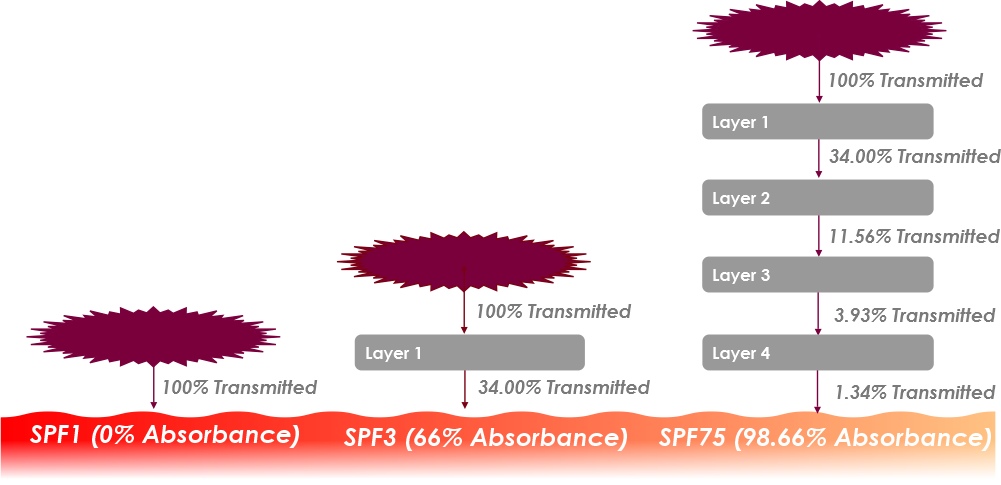
The quantity of UV light that passes through a sunscreen diminishes more and more as it passes through, a visual explanation is provided below using a SPF 3 (offering 30 minutes of protection) sunscreen absorbing 66% of light and applied in 4 layers to create protection equal to that of a SPF75 sunscreen (offering 750 minutes of protection), 25x more protection than a single layer:

SunscreenLayers

So what’s happening in the above diagram you may ask? The first layer absorbs 66% of the light, transmitting 34%, at this point we focus on what is being transmitted to illustrate, if the second layer transmits 34% of the 34% transmitted by the first layer, then the second layer transmits 11.56% (34% x 34%), the third layer transmits 34% of the 11.56% (11.56% x 34% = 3.93%) and so on and so forth.

The same works in reverse for a sunscreen which has been incorrectly applied as follows:

SunscreenQuantities

The above shows that using 1/4 (25%) of the recommended amount of SPF50+ sunscreen (offering 600 minutes of protection) creates protection equivalent to an SPF3 sunscreen (offering 30 minutes of protection). Going back to the original complaint where the consumer was found to have used 1/8th of the recommended amount, the equivalent protection is in fact less than SPF2, it was almost not worth the effort or expense applying any sunscreen!

The below graph may also help to explain the relationship between SPF and applied amount:


There have been a number of studies performed demonstrating how little sunscreen we as consumers apply and that sunscreen performance claimed is rarely achieved. I suggest that the underlying fault lies in the standards used to substantiate SPF where there is a huge difference between the amounts used to measure SPF in the laboratory and that typically used when we’re at the pool, beach or playing sport.

What does it all mean?

It is not necessarily reasonable to expect consumers to fully appreciate the amount we should be applying, we apply what feels right and what feels right is rarely the recommended amount! Logic suggests that the standards used to certify sunscreen should be updated to incorporate an amount that reflects what we use, or at least something more in-line with what we use, such that the claimed SPF is similar to that which we can expect to achieve. Having said that, the implications are that SPF50+ as the maximum claimable SPF isn’t likely to be reduced to account for a lower use amount so it really is up to the sunscreen industry to formulate product the encourages the use of more sunscreen, in the meantime however, we as consumers must learn to apply sunscreen properly.

It is simply not enough just to be wearing ‘some’ sunscreen, particularly if your intention is to be out in the sun for long periods of time, you must apply ‘a lot’ of sunscreen. If we were to think of UV radiation as a bullet with the potential to kill you, sunscreen could be thought of as a bullet proof vest and wrapping ourselves in aluminum foil is not going to stop a bullet… How much sunscreen should you apply, the answer is quite simply ‘a lot’.

And don’t forget to re-apply frequently!


Aerosol sunscreens – more harm than good?

Aerosol sunscreens – more harm than good?

I’ve always had reservations about the use of aerosol* based sunscreens since I had heard reports of people accidentally setting themselves on fire in the United States. Having seen an increased number of product performance complaints about aerosol based sunscreens, I had serious doubts about the ability for these products to achieve the claimed sun protection factor (SPF) and ability to prevent sunburn.

I have investigated the potential dangers of aerosol sunscreen using basic research and laboratory testing using an aerosol sunscreen that is currently on the market. While I don’t disagree with the convenience of the product and that it could encourage people to use sunscreen when they otherwise may not have and that there is a consumer demand for such products, the investigation show that my reservations were very much warranted. As I will now explain, while the products appear easy to use, they must be used with caution, so much so, that consumer should consider whether the ‘convenience’ of aerosol application is worth the risk associated with their use.


Flammability

As previously noted, there have been instances in the United States where people have caught on fire after applying aerosol based sunscreen products, causing serious burns. This is not surprising given the flammability of the Hydrocarbon (Butane) propellant/gas and Ethanol solvents used in these products. The dangers are clearly stated on pack in the form of a flammable goods placard and other written warnings on the dangerous and how not to use the product.

The risk remains that applying sunscreens around BBQ’s, people who are smoking and other sources of spark or naked flame can cause the product and persons wearing the product to catch on fire . The irony being while in the process of attempting to reduce the risk of sunburn we have increased the risk of an actual burn to our skin.


Asphyxiation

Asphyxiation refers to breathing in a gas/propellant with a reduced amount of oxygen in the air which lowers oxygen concentration in the blood stream, potentially leading to unconsciousness. Again, despite warnings on packs advising that sunscreens must be applied in a well-ventilated area, there is a risk that the user will apply the sunscreen in an enclosed space, potentially leading to asphyxiation and unconsciousness.


Explosion

No sunscreen should be left in a car which is in the sun (especially during summer) or exposed to direct sunlight or left anywhere where it may be exposed to temperatures over 30degC, as elevated temperatures will cause a degradation of the product and impact the claimed performance. The need to avoid high temperatures is even more important for aerosol sunscreens which are pressurized containers, as heat will cause the pressure within the can to increase and there is a risk of the aerosol explodin.


SPF testing and certification

The sun protection factor (SPF) of aerosol sunscreens aren’t tested and certified in the laboratory using the same application methods used for regular sunscreens and by us as consumers. The reason for this is one of practicality; the propellant/gas in the aerosol makes following the standard test method virtually impossible as the amount dispensed and applied to the skin cannot be accurately measured as the packaged product in its original form is so volatile, because of this, an alternative method is used. During laboratory testing, the volatile propellant/gas is removed from the aerosol can before testing starts, leaving only the liquid inside, this liquid is then tested in the same way as with a regular sunscreen. The propellant/gas accounts for around 40% of the contents of the aerosol, meaning 40% of product is lost during the application process with only 60% of the contents having the ability to reach our skin where it can provide the necessary protection.

The above is not a flaw in the test used to certify the SPF, however it does impact the products ability to achieve its stated SPF as a result of needing more sunscreen to be applied than would be thought necessary.

Following on from the above, when tested in the laboratory, the product is physically applied to human skin and ‘rubbed’ in, however the directions and the aerosol packaging require that the product be sprayed directly onto your skin. The spray application can affect the quality of the sunscreen layer that is formed and subsequently the quality of protection. The image below shows a close-up photo of the sunscreen after application using the sunscreen liquid rubbed on vs directly sprayed on from the aerosol sunscreen packaging, you can clearly see the difference in texture of the sunscreen and these differences could affect the quality of protection:

AerosolSunscreen


Loss during application

Because of the gas/propellant and the fine mist released during use, the amount of product that comes out of a can of aerosol sunscreen is not the same as what ends up on our skin. Most brands recommend spraying the product 10-15cm away from our skin and laboratory testing under ideal conditions (i.e. indoors – well ventilated area, no wind) using these guidelines found that only around 40% of the amount dispensed from the pack actually ends up on the skin. The loss of 60% of the product in application is now 20% above the gas/propellant loss outlined earlier where it was estimated 60% would reach the skin this additional loss is attributable to ‘overspray’. This loss in application would be worse if there were a breeze, if the area of application was small (such as a child’s arms and legs) or was being applied from a distance greater than the recommended 10-15cm.

Combining the amount of gas/propellant lost during application and the overspray, the total loss during application is significant at 60% of the amount in the aerosol, with only 40% reaching the skin where it can provide the necessary protection. 

AerosolSunscreen3


Change in pressure and amount applied

Over the life of an aerosol as the product is used, the amount of product/propellant in the can becomes less and this reduces the pressure within the aerosol. The pressure in the aerosol is responsible for the product being released during application, less pressure in the aerosol can results in the amount of product dispensed over a particular time becoming less. Some research found that the product would need to be sprayed 45% longer as the can approaches being empty to allow the same amount of product out of the can. Whilst it is reasonable for a user to take additional time to ensure proper application, given the sunscreen is transparent, it would be difficult for a person to understand that this would be necessary to ensure they achieve the claimed level of sunscreen protection (SPF).

Similarly, ambient temperatures can impact the aerosol pressure. Cooler temperatures reduce the pressure and the application amount, whilst warmer temperatures will increase the pressure and increase the application amount.


Understanding the application properties

To achieve the claimed SPF for regular sunscreen (non-aerosol), the average adult requires approximately 36g of product when being applied over the entire body, for the golfers out there; this is roughly the size of a golf ball in terms of volume, for the cooks, its 1.5-2 tablespoons. It is difficult enough for a person using a regular sunscreen lotion to understand what this means when sunscreens aren’t sold in golf balls and we don’t carry a set of measuring spoons. It’s even more difficult to comprehend when using an aerosol sunscreen and the dispensed product which is bordering on invisible!

I decided to try applying the sunscreen for myself to see how much sunscreen reaches my skin, weighing the aerosol before and after application, timing the application to get an idea of how long the process takes and applying what ‘felt’ appropriate.  I spent a total of 2 minutes applying the aerosol sunscreen and calculated that roughly 35g of product was dispensed from the aerosol. Allowing for the gas/propellant and over-spray, I estimated 40% of the 35g would have reached my skin, meaning 14g of sunscreen reached my skin, which is just 35-40% of what I should be wearing to achieve the claimed level of sun protection (SPF)


So, should I use aerosol sunscreen?

Using the diagram above as a guide, an adult who would normally require 36g of product would need 90g from an aerosol sunscreen to obtain the 36g of product. The 90g required makes ~4.5 minutes of continuous spraying to achieve, 4.5 minutes spraying a flammable product which dramatically increases the likelihood of catching fire!

Below is the previous diagram showing the weight distribution during application to clarify.

AerosolSunscreen2

This means that for the average adult applying sunscreen to their entire body, you should be getting only 2 applications from the average 175g can (2 applications x 90g = 180g, a fraction more than the 175g in the average aerosol).

Going back to my experiment where I applied 40% of the recommended amount of sunscreen onto the skin i.e. 14g of the 36g dispensed as a result of propellant/gas and over-spray, I calculated that the SPF50+ sunscreen (over 500 minutes of protection) was now only SPF5 (50 minutes of protection), less than 10% of the claimed protection.

The dramatic reduction in protection when combined with the increased risks of flammability and explosion, I know that I won’t be using aerosol based sunscreens, having said that however, aerosol sunscreens are safe to use when used correctly, so for those who prefer the convenience of using aerosols, please use this article as a guide to how best to achieve the most out of your favorite sunscreen and minimize the risk.

*Aerosol in the context of this article refers to aerosol spray/mist type packaging as distinct from other forms of aerosol, including bag-on-valve and bag-in-can where the propellant is separated from the product, as used for dispensing creams, lotions and gels which don’t have the same dangers with respect to flammability, asphyxiation, explosion, losses during application etc.

http://www.fda.gov/downloads/ForConsumers/ConsumerUpdates/UCM258910.pdf